
By Keiter CPAs
Practical tax planning strategies for individuals and businesses in 2026
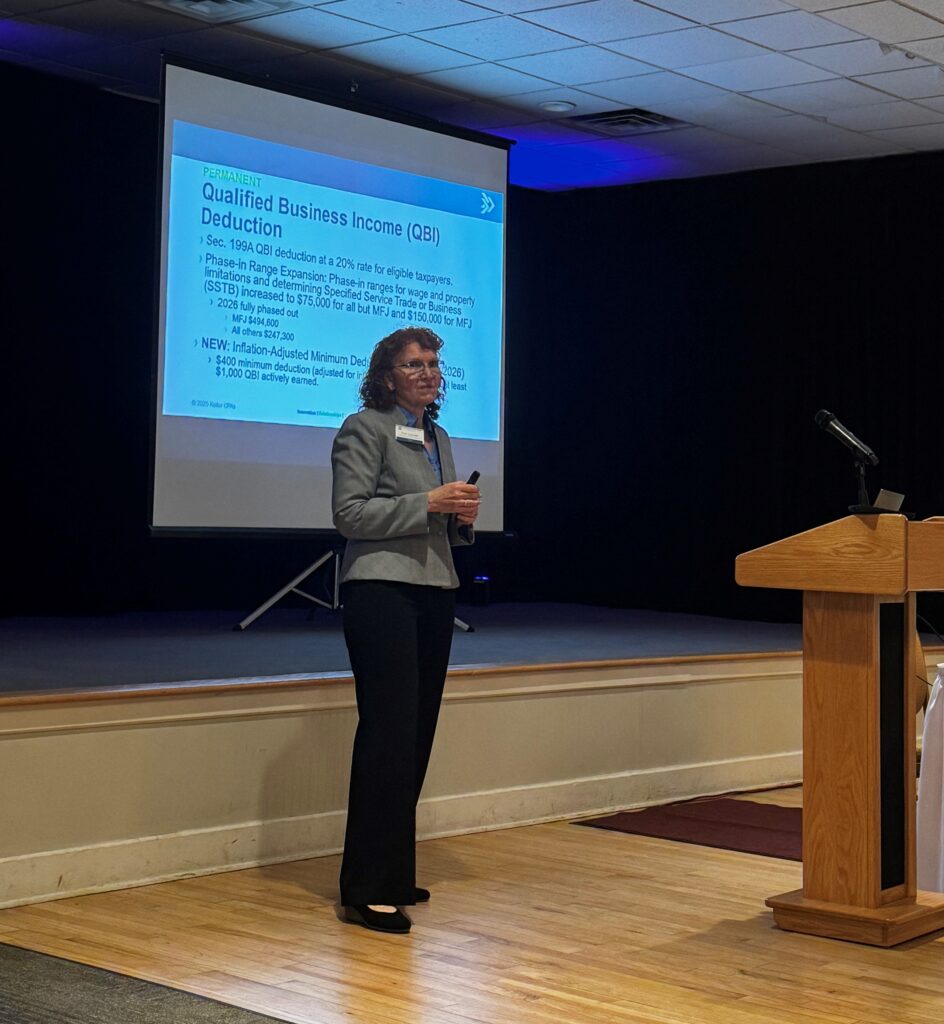
During a recent presentation to the Accounting & Financial Women’s Alliance (AFWA) Richmond Chapter, Keiter Tax Senior Manager Kay Gotshall discussed the potential planning implications of the One Big Beautiful Bill Act (OBBBA) and how the legislation may affect individuals, families, and business owners beginning in 2026.
While many provisions build on the Tax Cuts and Jobs Act (TCJA), the legislation also introduces new income-based limitations, deduction thresholds, and planning considerations that make proactive tax strategy increasingly important.
A common theme throughout the legislation is the growing importance of adjusted gross income (AGI). Many deductions and credits now phase out at certain income levels, making multi-year planning and income coordination more valuable than ever. As a result, AGI management is becoming central to effective tax planning under the new law.
Key changes for individuals
Estate and gift tax exemption increases
Beginning in 2026, the federal estate and gift tax exemption increases permanently to $15 million per taxpayer, indexed for inflation. Although this may reduce estate tax exposure for many families, reviewing estate plans, trusts, and beneficiary structures remains important to support long-term family and financial goals.
Standard deduction and tax rates remain favorable
The top individual tax rate remains at 37%, and the expanded standard deduction becomes permanent. Projected 2026 standard deduction amounts include:
- $16,100 for Single / Married Filing Separately
- $24,150 for Head of Household
- $32,200 for Married Filing Jointly
Charitable giving requires more planning
New charitable contribution rules introduce both income thresholds and deduction limitations. Taxpayers may benefit from coordinating charitable giving strategies more intentionally through:
- Bunching donations into higher-income years
- Donating appreciated securities
- Using Qualified Charitable Distributions (QCDs)
- Managing AGI levels strategically
Beginning in 2026, taxpayers who claim the standard deduction may also deduct up to $1,000 in cash charitable contributions ($2,000 for married filing jointly). Taxpayers should retain receipts and any supporting documentation for all charitable donations claimed.
SALT deduction changes
The legislation temporarily increases the state and local tax (SALT) deduction cap from $10,000 to $40,000 through 2029. However, income-based phaseouts may reduce the benefit for higher-income taxpayers, making planning around modified AGI increasingly important.
For many Virginia pass-through business owners, the Virginia Pass-Through Entity Tax (PTET) election may continue to provide valuable federal tax planning opportunities.
AGI management takes center stage
Many tax benefits under the OBBBA are now tied directly to AGI thresholds, including:
- SALT deductions
- Child-related credits
- Age-based deductions
- Tip and overtime deductions
- Car loan interest deductions
- Qualified Business Income (QBI) deductions
As a result, taxpayers may benefit from taking a more proactive approach to income planning by evaluating the timing of:
- Roth conversions
- Retirement contributions
- Capital gains recognition
- Business income recognition
- Charitable giving strategies
Coordinating these decisions across multiple tax years may help improve long-term tax efficiency as more deductions and credits become tied to AGI thresholds. In many cases, steady income management across multiple years may create better long-term tax efficiency than year-by-year reactions.
Business tax provisions
The legislation also includes several favorable business provisions, including:
- Return of 100% bonus depreciation and Increased Section 179 expensing limits
- For larger businesses, interest limitation under Sec 163(j) is based on EBIDTA
- Immediate expensing of domestic research and development (R&D) costs
- Relief from certain 1099 reporting requirements
For Virginia businesses, state conformity differences continue to require additional tracking and planning, particularly related to depreciation, interest deductions, and R&D expenses.
Family and education opportunities
Additional updates include:
- Expanded Child Tax Credit provisions
- Higher Dependent Care FSA limits
- Expanded 529 plan uses for education expenses
- New tax-deferred “Trump Accounts” for minors beginning in 2026
These changes may create additional planning opportunities for families focused on education funding and long-term savings.
Planning ahead matters
As more deductions and credits become tied to income thresholds, proactive tax planning may help individuals and businesses better align tax decisions with broader financial goals.
Areas worth reviewing include:
- Multi-year income planning
- Business entity structure
- Retirement and charitable giving strategies
- Capital investment timing
- State and federal tax coordination
The One Big Beautiful Bill Act creates both opportunities and complexity for taxpayers in 2026. While many of the changes may reduce taxes or provide additional deductions, the new rules also introduce numerous AGI-based phaseouts, deduction limitations, and planning considerations. With so many moving pieces taking effect in 2026, now is the time to evaluate how the OBBBA’s practical tax planning strategies may impact your personal and business financial goals.
Contact your Keiter Opportunity Advisor to discuss how the One Big Beautiful Bill Act may impact your personal and business tax planning strategies.
About the Author

Keiter CPAs
Driven by our core values of innovation, collaboration, relationships, and accountability, we serve as trusted Opportunity Advisors, providing tailored advice to help you make confident, forward-looking decisions.
Our comprehensive services include audit and assurance, tax, cybersecurity, risk advisory, client accounting and finance services, valuation and forensic services, and transaction advisory services. We specialize in supporting entrepreneurs, private business owners, and organizations across industries such as financial services, construction, healthcare and medical services, real estate, manufacturing, retail and distribution, private equity and institutional investors, technology and nonprofits.
More Insights from Keiter CPAsThe information contained within this article is provided for informational purposes only and is current as of the date published. Online readers are advised not to act upon this information without seeking the service of a professional accountant, as this article is not a substitute for obtaining accounting, tax, or financial advice from a professional accountant.