
By Tianna Wooldridge, CPA , Business Assurance & Advisory Services Manager

How to avoid common SEFA errors during a Single Audit
If your organization expended federal funds that cumulatively exceeded one million dollars during the fiscal year, chances are that your organization will be required to have a Single Audit performed.
What is a Single Audit?
The Single Audit Act of 1984 established requirements for audits of states, local governments, Indian Tribal governments, and non-profit organizations that administer federal financial assistance programs. Single Audits are required for recipients who expend at least one million dollars in aggregate federal financial assistance, whether received directly from the federal government or as a subrecipient, within their fiscal year.
The backbone of the Single Audit is the Schedule of Expenditures of Federal Awards, better known as the SEFA. This schedule is prepared by the recipient of the federal funds to summarize all the expenditures incurred during the fiscal year by audit award under each federal program. The auditor uses the SEFA to identify which program(s) to audit. An incomplete SEFA can delay the Single Audit process which could ultimately make the audit more costly for the organization.
Based on our audit experience, we compiled a few common mistakes in preparing the SEFA and provided tips to avoid the same mistakes:
- Excluding a grant from the SEFA. Centralize and read ALL grant and contribution award agreements. Typically, those responsible for preparing the SEFA may only see the funds received/expended and rely on the operating or fund development team to inform them if the funds are federal versus general contributions. Trust but verify! Most federal grants, even if they are passed through an agency or another organization, are easily identifiable based on specific language in the award agreements like a Federal Assistance Listing number, program or cluster numbers or titles, or specific Single Audit requirement language. If you are unsure whether a grant is federally funded, you can look up the grant name or assistance listing number on Sam.gov. You can also confirm with the grantor.
- Missing elements of the SEFA. The complete SEFA is the responsibility of the recipient. Familiarize yourself with the core elements of the SEFA – name of the federal agency & pass-through entity (as applicable), assistance listing number, federal program name, award number/contract number, total expenditures during the fiscal year (not the grant award period), and amounts provided to subrecipients (as applicable). You should be able to complete most elements of the schedule using the repository of grant documents and award agreements you compiled from tip #1 above. See below for a sample of the SEFA.
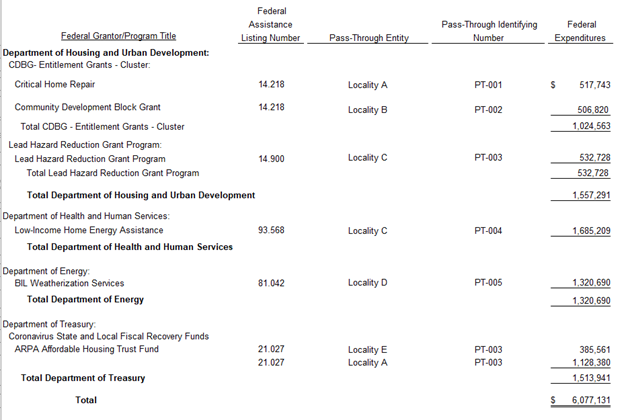
- Inaccurate total expenditure amount on the schedule. Tie the total expenditure amount back to your general ledger. Many organizations can benefit from organizing their accounting software to automatically categorize expenditures appropriately. Establish an internal control process to prepare, reconcile, and review the SEFA. Ensure there is an appropriate segregation of duties for this process. Your auditors will appreciate it.
- Mixing up the grant period and the fiscal year. Oftentimes, the grant period will not align with your fiscal year. Regardless of the grant period, if the funds are expended during the fiscal year, the amount expended needs to be included on the SEFA.
- Including the award amount instead of the amount expended. Many organizations report the amount awarded versus expended on the SEFA. Once you have identified the amount expended for each award using the suggestions from tip #3, include those expended amounts on the schedule. The awarded amount is useful information to the organization and for managing the grants but not required on the SEFA.
By taking these proactive steps to ensure your SEFA is both complete and accurate, you can help streamline the Single Audit process and avoid unnecessary delays or added costs. Thorough preparation not only supports compliance but also demonstrates strong financial stewardship within your organization.
If you have questions about preparing your SEFA or need additional guidance, contact your Keiter Not-for-Profit Opportunity Advisor for support tailored to your organization’s needs.
About the Author

Tianna Wooldridge, CPA , Business Assurance & Advisory Services Manager
Tianna is a Manager on the Business Assurance and Advisory Services team. She specializes in real estate and construction, non-profit organizations, and tax credits and is an active member of both the Real Estate and Construction and Not-for-Profit niche groups.
More Insights from Tianna WooldridgeThe information contained within this article is provided for informational purposes only and is current as of the date published. Online readers are advised not to act upon this information without seeking the service of a professional accountant, as this article is not a substitute for obtaining accounting, tax, or financial advice from a professional accountant.