
By Keiter CPAs

Asif Charania and Scott Zickefoose share insights at the Richmond Chapter of the VSCPA
Valuation is not determined by a single industry benchmark, it is shaped by risk, cash flow durability, deal structure, tax considerations, and how well the business is prepared for scrutiny. Keiter Valuation and Forensic Services team leader, Asif H. Charania, CPA/ABV/CFF, ASA, Partner and Keiter Advisors leader, Scott Zickefoose, CPA, CM&AA, Partner presented at the Richmond Chapter of the VSCPA on the topic Navigating Business Transactions for Controllers and CFOs. Here are the key insights they shared that every financial leader should understand before entering a transaction.
Key takeaways
- Valuation is driven by risk and durability, not just growth.
- A valuation multiple is simply the inverse of required return. Small improvements in perceived risk can materially expand multiples.
- Enterprise value, equity value, working capital adjustments, debt-like items, and tax structure all determine what sellers actually take home.
- Transaction structure determines who bears risk.
- Preparation begins years before a sale. GAAP-ready financials, clean balance sheets, disciplined reporting, contract clarity, and tax planning should begin 2–3 years before going to market.
How businesses are valued and why multiples are not enough
Buyers rely on three valuation approaches when considering a transaction.
- The Income Approach looks at expected future cash flows and discounts them based on required return.
- The Market Approach references comparable public companies and prior transactions to derive valuation multiples.
- The Asset Approach focuses on adjusted net asset value and is typically more relevant for asset-heavy or underperforming businesses.
In practice, the Income and Market approaches dominate operating company transactions, and both ultimately reflect the same core concept: the higher the perceived risk, the higher the required return, and the lower the multiple. This is why blanket industry averages can be misleading. Profitability, growth durability, capital intensity, and company size all influence risk, and scale alone often commands a premium. In middle‑market transactions, pricing usually centers on market multiples, but income‑based analysis validates whether those prices make economic sense. Understanding the relationship between required return and valuation is essential to understanding how buyers actually price a deal.
Creating value by reducing risk
In today’s market, reducing risk often creates more value than growth alone. A higher multiple is earned when buyers believe cash flow is durable, predictable, and defensible. Quality of revenue matters more than volume: recurring contracts, diversified customers, visible backlog, and stable margins reduce uncertainty. Conversely, heavy customer concentration, key-person dependence, inconsistent earnings, or significant capital expenditure needs increase perceived risk and compress valuation. Management depth also plays a key role. Businesses that can operate and grow without the owner command stronger pricing because buyers see continuity and scalability. While increasing EBITDA can certainly raise value, multiple expansion often comes from de-risking the business by strengthening contracts, broadening the customer base, institutionalizing reporting, and building a capable leadership team.
The Equity Bridge: Headline price vs. net proceeds
The headline purchase price is only the starting point, what ultimately matters to a seller is the equity value they receive at closing. Buyers negotiate on an enterprise value basis, but that number is adjusted for net debt, working capital targets, and other debt-like items to arrive at actual proceeds. Items such as deferred revenue, accrued bonuses, customer deposits, lease obligations, and unresolved tax exposures can reduce cash at closing dollar for dollar. Working capital true-ups can also create unexpected post-closing adjustments if targets and calculation methods are not clearly defined. This “equity bridge,” the path from enterprise value to equity value, is where many surprises occur, and where preparation and financial discipline directly impact net proceeds. Understanding these mechanics helps owners evaluate offers more effectively and avoid mistaking a strong headline multiple for guaranteed take-home value.
Structure matters as much as price
Not all deals are created equal, even when the headline valuation looks similar. For example:
- A strategic buyer may offer a higher multiple and more cash at closing, often transferring most of the performance risk at exit.
- Private equity transactions, by contrast, frequently include rollover equity, allowing sellers to retain 5–20% (or more in platform deals) and participate in a potential “second bite” when the business is sold again. That upside comes with continued risk, governance changes, and leverage considerations.
- Employee Stock Ownership Plans (ESOPs) and internal succession transactions can preserve culture and legacy, but they are typically constrained by the company’s ability to service debt, meaning sellers often retain financial exposure over time.
Ultimately, transaction structure determines who bears operational, financial, and market risk after closing and who benefits from future growth, making it just as important as the headline price.
The CFO and Controller’s role across the transaction lifecycle
A company’s valuation is heavily influenced by the quality and credibility of its financial information, making finance leaders some of the most influential members of the seller’s team. Preparation directly affects valuation, timing, and proceeds. Below is an example of the evolving role a CFO or Controller plays during the transaction lifecycle.
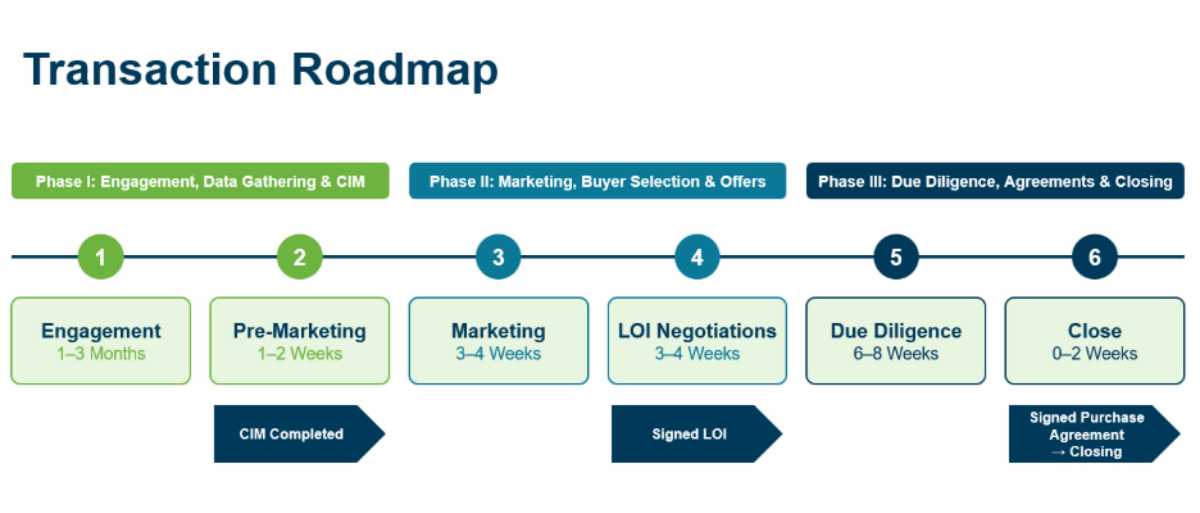
- Phase I: CFO leads data room preparation and financial narrative development
- Phase II: Monthly financials must be timely; CFO fields post-CIM diligence questions
- Phase III: CFO manages 600+ diligence requests; owns working capital target defense
The 3-year path to transaction readiness
The most successful exits are rarely the result of last-minute cleanup. Preparation truly begins years before a sale, not when a letter of intent is signed. Companies that command stronger valuations typically spend two to three years building GAAP-ready financial statements, cleaning up balance sheet anomalies, tightening revenue recognition policies, formalizing contracts, and implementing disciplined monthly reporting processes. This groundwork strengthens reporting infrastructure, reduces working capital and debt-like surprises, and positions the company for a smooth sell-side quality of earnings review. For finance leaders and private business owners alike, disciplined preparation is not just good governance; it is a direct driver of valuation and negotiating leverage when it matters most.
Business Valuation and Transaction Advisory teams work with owners, CFOs, and controllers to strengthen financial readiness, evaluate deal structure alternatives, and navigate the equity bridge with confidence. To discuss how to position your business for a successful transaction, contact your Opportunity Advisor | Email | Call: 804.747.0000.
About the Author

Keiter CPAs
Driven by our core values of innovation, collaboration, relationships, and accountability, we serve as trusted Opportunity Advisors, providing tailored advice to help you make confident, forward-looking decisions.
Our comprehensive services include audit & assurance, tax, cybersecurity, risk advisory, client accounting & finance services, valuation & forensic services, and transaction advisory services. We specialize in supporting entrepreneurs, private business owners, and organizations across industries such as financial services, construction, healthcare and medical services, real estate, manufacturing, retail & distribution, private equity and institutional investors, technology and nonprofits.
More Insights from Keiter CPAsThe information contained within this article is provided for informational purposes only and is current as of the date published. Online readers are advised not to act upon this information without seeking the service of a professional accountant, as this article is not a substitute for obtaining accounting, tax, or financial advice from a professional accountant.